
The incredible story of the Vasa
2024-12-14
On 10th August, 1628, the Swedish navy launched the maiden voyage of the Vasa .The Vasa was part of the military expansion and an expression of Swedish naval power: It was explicitly built at the order of the King of Sweden Gustavus Adolphus, and was richly decorated to show off Swedish might and wealth. No expense was spared. One of the rooms was made to look like the royal palace. There were numerous Roman statues on board, where king Adolphus was sending a message that ‘hey, Sweden is the modern Roman empire’. Upon completion, it was one of the most powerful armed vessels in the world.
August 10 was a calm day, perfect for a launch, with a light breeze from the southwest. It passed the Royal palace, and the gun ports were opened for a Royal salute. When doing so, a gust of wind -nothing crazy - filled its sails and it heeled to the port. It passed some bluffs to the south (Södermalm, for those familiar with the geography). A little later, at Tegelviken, a stronger gust caused it to again heel to the port side - and went past the point beyond which the ship could right itself. The gun ports were open because 1300 meters past its launch, the Vasa sank, and about 30 people died (it included women and children as well, since it was a ceremonial trip around the harbor). It took all of 5 minutes to sink, and a major reason was the lower gun ports were open and water poured in as it heeled. But more on this later.
The Vasa lay on the bottom of the Stockholm harbor for 333 years, before it was successfully raised and the Vasa museum captures its stunning story of mismanagement, in a fashion eerily similar to mismanagement as seen in some modern software companies. I was lucky enough to have a tour through this museum while on a work trip to Stockholm. I would visit Stockholm again just to go back to the museum (though Stockholm has so much to see and do)
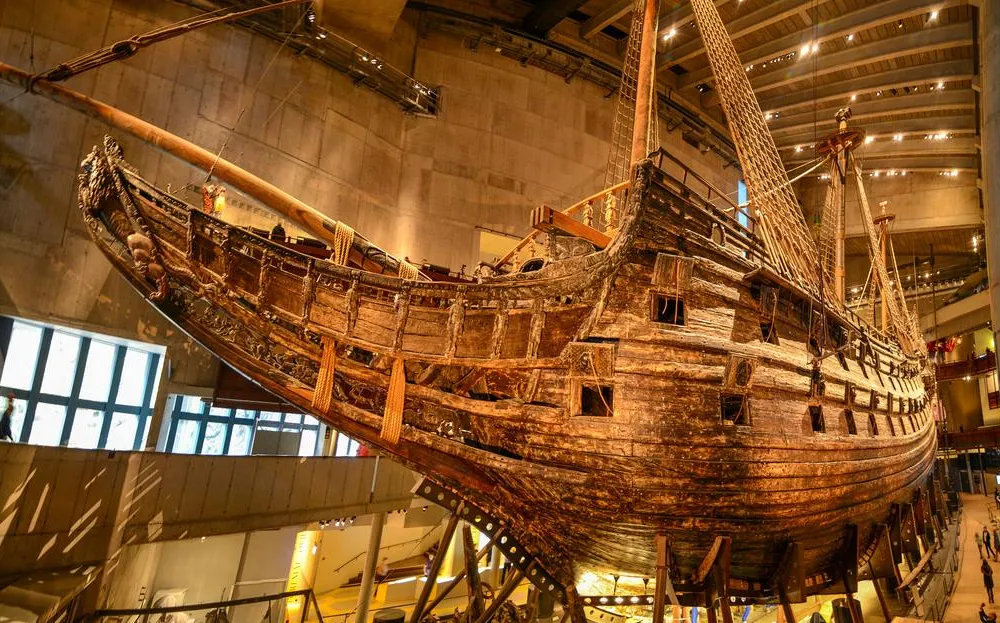
The Vasa's story serves as a powerful metaphor for modern software companies, particularly in how organizational dynamics can lead to technical disaster. Just as Vasa's builders continued with a fundamentally flawed design due to royal pressure, software teams sometimes proceed with architectures or technical decisions they know are problematic due to executive mandates or market pressures. The tragic part of Vasa’s story is that it was known that it was unlikely to survive its launch. In 1628, the captain arranged for the Vice Admiral to demonstrate its stability. 30 men ran back and forth across the upper deck, and the ship started to roll. The Admiral stopped the test because he was afraid the ship would capsize in the harbor. Does this sound familiar to anyone?
Too big to fail
Consider how often we see software projects that are "too big to fail" - platforms or products that have had so much investment and executive attention that stopping to address fundamental issues becomes politically impossible. Like the Vasa's gun ports being open for a royal salute (a political requirement) directly contributing to its sinking, we often see technical compromises made for business optics that ultimately undermine the product's stability.
The parallel extends to modern engineering organizations where technical experts - much like the shipbuilders of the Vasa - might recognize fundamental flaws but feel unable to effectively raise these concerns up the chain of command. In both cases, the culture of deference to authority and the pressure to deliver can override technical wisdom. Today's "royal demands" might come in the form of arbitrary deadlines, feature requirements that compromise system stability, or architectural decisions made to align with executive presentations rather than engineering realities. There is a tendency to ‘drift to failure’ in organizations that show up only when it blows up in their faces.
Most tellingly, just as the Vasa's builders had proven experience with smaller ships but ran into trouble when scaling up to a larger, more complex vessel, software companies often face challenges when scaling from successful smaller systems to more complex platforms. The same principles that worked at a smaller scale can become catastrophic liabilities when applied without adaptation to larger, more complex systems.
The 5 whys
This is a standard practice in product development (my writeup on it can be read here). Well, certainly at every place where I had influence over the process. It is entertaining to turn the 5 Why’s framework on the Vasa to get to root cause: King Adolphus was furious, of course, and the loss of his statement piece, and the loss of the many cannons that were on the Vasa (2 gun decks that can be seen in the photo above - it had 64 cannons). There was a royal inquiry, and no one was found guilty - it would be foolhardy - deadly - to point the finger at the king, who was responsible for the tragedy.
So what would the 5 Why’s for the Vasa look like?
Why did the Vasa sink?
The ship capsized and sank about 1,300 meters into its maiden voyage in Stockholm harbor on August 10, 1628. A light gust of wind caused it to heel (tilt) severely to port. Water rushed through the open gun ports, which were only 1.2 meters above the waterline, flooding the ship and causing it to sink within minutes.
Why did a light wind cause such severe heeling?
The Vasa was dangerously unstable due to its top-heavy design. The ship carried 64 heavy bronze cannons, mostly on the upper gun deck. More critically, the ship's ballast (72 tonnes) was insufficient to counterbalance the weight of the upper structure, guns, and heavy decorative sculptures. Stability tests before launch showed the ship was dangerously unstable - it heeled severely when just 30 men ran from side to side.
Why wasn't the stability issue addressed when it was discovered?
Despite shipbuilder Jakobsson noting the stability problems during construction, and despite a stability test where the ship dangerously heeled, no significant changes were made. Admiral Fleming, who oversaw the test, feared reporting the full extent of the problems to the king. The shipbuilders and naval officers knew of the issues but proceeded with the launch anyway.
Why didn't the shipbuilders or naval officers intervene more forcefully?
In Swedish society under King Adolphus, challenging royal authority was unthinkable. (Note: This is of course not particular to Swedish culture). The king had personally ordered multiple changes during construction, including the second gun deck and additional heavy bronze cannons. He was deeply involved in the design, viewing the Vasa as a symbol of Swedish naval power. No one, including the shipwright, dared question the kings demands.
Why was the cultural dynamic so resistant to raising safety concerns?
Sweden in the 1620s operated under absolute monarchy where the king's word was literally law. King Adolphus had transformed Sweden into a major military power, leading successful campaigns in the Thirty Years' War. The hierarchical culture of 17th-century Sweden, combined with the king’s reputation as a militant leader, created an environment where professional expertise was subordinate to royal authority. There was no cultural framework for "speaking truth to power" - the concept itself would have been alien to most 17th-century Swedes.
Root Cause:
The fundamental issue was a cultural environment that prioritized deference to authority over technical expertise and safety concerns. This cultural dynamic made it impossible for technical experts to effectively challenge decisions that compromised the ship's safety, even when they recognized the dangers.
The tragic irony is that Adolphus, despite his direct involvement in the ship's design changes, never saw the Vasa - he was away on campaign in Poland when it sank. The culture of absolute deference to royal authority operated even in his absence, preventing necessary corrections to a fatally flawed design.
Well, that is the Vasa. And we have many modern day examples. I’d love to hear about your experiences - maybe feature it in a future newsletter?
That's it for now. More updates on the progress we have made on Intermezzo.ai (does not look one bit like the Vasa!) coming soon. We are deep into fundraising, and will share more soon.
Siddharth